Capabilities
Radio & network
Sealed RF containmentstock (upstream)
~60–90 dB
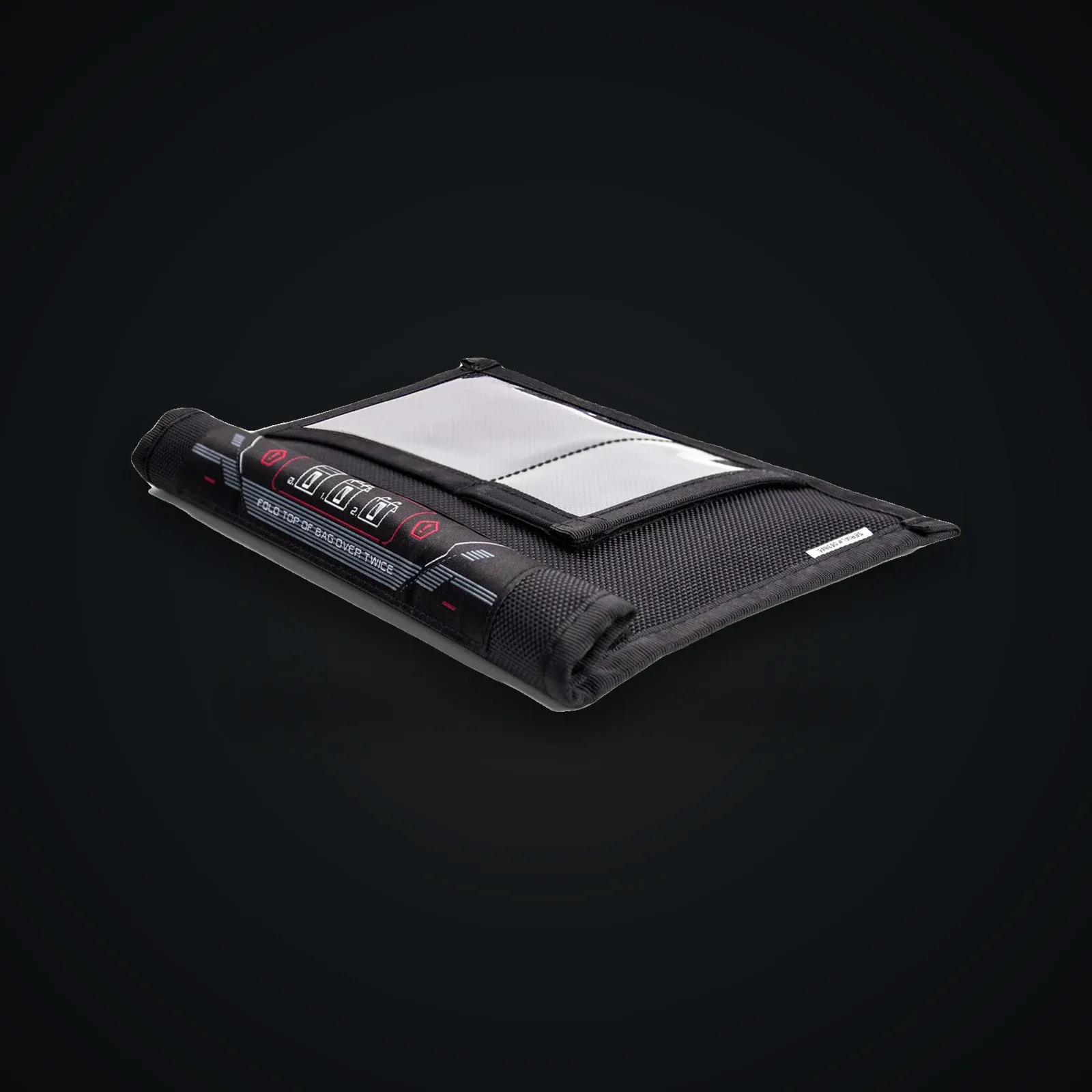
A Faraday sleeve attenuates radios (~60–90 dB) — only when fully sealed.
− Only when the sleeve is fully sealed.
Source● stock (upstream)◆ onsecret workshop○ option— absent
What this does not protect against
- Only blocks while fully sealed and closed. An open, partially rolled, or torn pouch provides little to no attenuation; a worn closure is the most common failure point.
- Does not stop on-device data collection. The phone can still record audio, photos, sensor data and GPS fixes internally while bagged and transmit them once removed.
- Does not defeat the cellular baseband or stored identifiers (IMEI/IMSI). The network still has your prior connection history; once you reopen the pouch the device re-registers and location resumes.
- Does not protect against theft, coercion, physical seizure, or forensic extraction. Forensic Faraday bags are designed to keep seized phones live for tools like Cellebrite/GrayKey.
- High-band 5G mmWave (>20 GHz) and very high frequencies are generally untested and may be attenuated less; effectiveness also varies between phone makes and models.
- Provides no anonymity or deanonymization protection. It hides nothing about your account, SIM, payment trail, or behavior — only RF emission during the sealed window.
What the workshop does to this device
Our pipeline
- USB keys: imaged at the workshop, signature-verification procedure provided — don't take our word for it.
- Passive accessories (Faraday sleeve, data-blocker): checked, shipped as-is — nothing to configure.
What you can ask us
- Questions: Signal / PGP / anonymous ticket.
- Re-imaging of a key on request.
What we do not do
- No software added to passive accessories.
- No remote support (no connected device).
What it is
What it is
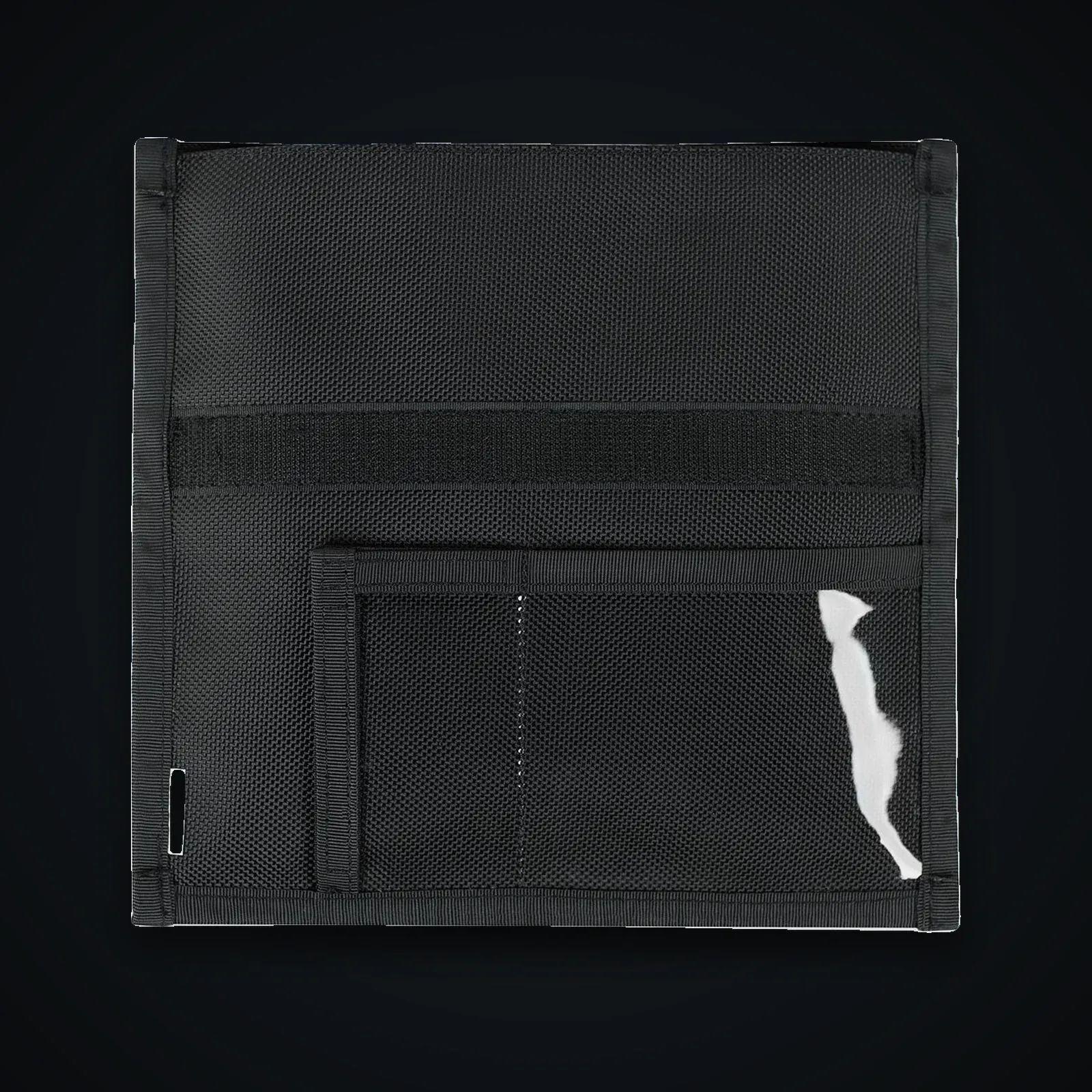
A Faraday pouch is a passive enclosure made of conductive fabric that attenuates radio signals entering or leaving the device inside it. While the pouch is fully sealed, a phone, tag, key fob or hardware wallet cannot reach a cell tower, Wi-Fi access point, Bluetooth peer, GNSS satellite or RFID reader. There is no battery, firmware or logic — the physics do the work, and only while the seam is closed.
Honest positioning
This is a containment tool with a narrow, well-defined job: stop RF for a bounded window of time. Independent testing (Matt Blaze, using a Rohde & Schwarz PR100 in an RF chamber) measured 89–110 dB of attenuation across 1–6 GHz on good commercial pouches, with roughly ±10 dB uncertainty and noticeable drop-off when a closure was imperfect. Cheap "metallic-look" pouches can deliver almost nothing. A pouch is only as good as its weakest seam.
What it does not do
A Faraday pouch does not change anything the device knows or stores, and it does not touch the network's record of you. The baseband, IMEI/IMSI, your SIM, your accounts and your past location history are untouched; the moment you reopen the pouch, the device re-registers and tracking resumes. It also cannot stop a phone from recording audio or sensor data internally for later upload. Treat it as airplane-mode-you-can-physically-trust for short periods — not as anonymity, and not as a defense against seizure or forensic extraction.
Usage guide
Setup and first-use verification
A Faraday pouch needs no configuration, but you should verify it works before relying on it — attenuation depends entirely on the seam, and units vary.
Quick acceptance test (do this on day one)
- Call test. Put the powered-on phone inside, seal fully, and call it from another phone. It should go straight to voicemail / unreachable. Reopen — it should reconnect within seconds.
- Bluetooth/Wi-Fi test. Pair the phone to a Bluetooth speaker or keep an active Wi-Fi stream; sealing the pouch should drop the link. SLNT documents exactly this four-part method (call / Wi-Fi / Bluetooth / RF).
- Location test. Use a friend's "Find My"/locator on the device; the last fix should freeze while sealed.
If any signal survives a *full, correct* seal, the pouch (or its closure) is inadequate — return it.
Daily use
- Seal completely, every time. For roll-tops, roll the documented number of folds and secure both clasps; for hook-and-loop, press the full overlap. Most real-world failures are an incompletely closed pouch, not bad fabric.
- Don't overstuff. Cables or a second device can hold the seam open a few millimeters — enough to leak.
- Power down for the strongest guarantee. A sealed pouch blocks RF, but a powered phone still records sensors and burns battery hunting for signal at full transmit power (older phones especially). If you only need to stop emission, sealing is enough; if you want to stop *collection*, power off first.
- Mind heat and battery. A live phone transmitting at max inside a sealed pouch runs warmer and drains faster. Don't leave a live device bagged for long periods.
Hardening
- Combine, don't substitute. Enable airplane mode *and* bag the device. On GrapheneOS, airplane mode fully disables the cellular radio; the pouch is your physical fallback if a setting fails or an app re-enables a radio.
- Address the device, not just the RF. The pouch does nothing about EXIF metadata, account linkage, or on-device logging. Pair it with disciplined OS/app hygiene.
- Inspect the seam regularly. Conductive thread and plated fabric degrade with flexing, abrasion and washing. A frayed or creased closure loses attenuation silently.
- Avoid washing. Most conductive fabrics lose shielding when laundered; follow the maker's care instructions or replace.
Pitfalls
- "It looks metallic so it works." Decorative fabrics can give <10 dB. Only a sealed, tested, multi-layer conductive pouch is meaningful.
- Trusting it against seizure. Forensic-grade Faraday bags exist specifically to keep a *seized* phone live and isolated for extraction with Cellebrite/GrayKey — the bag protects the investigator's evidence, not your secrets. A pouch is not a defense against physical custody.
- mmWave gap. High-band 5G (>20 GHz) is often untested; don't assume coverage there.
- Forgetting the re-registration moment. The instant you reopen the pouch, the device rejoins the network and location resumes. The protected window ends the moment the seam opens.
How to verify integrity over time
Re-run the call/Bluetooth/RF acceptance test monthly and after any drop, wash, or visible wear. For a quantitative check, a cheap RF detector or SDR placed inside vs. outside a sealed pouch will show whether a known transmitter still leaks — the same principle Matt Blaze used in his phone-sized Faraday bag tests. If attenuation has dropped, retire the pouch.
Specifications
| Function | Passive RF enclosure (Faraday shield) — attenuates radio signals in and out while sealed |
|---|---|
| Signals attenuated | Cellular (2G–5G sub-6), Wi-Fi 2.4/5 GHz, Bluetooth, GNSS/GPS, RFID/NFC, UWB |
| Typical attenuation (good pouches) | ~60–90 dB average; independently measured 89–110 dB from 1–6 GHz on EDEC OffGrid / Mission Darkness samples (Matt Blaze, R&S PR100) |
| Measurement uncertainty | ~±10 dB in field/chamber tests; performance varies by phone model and seal |
| Closure | Roll-top or hook-and-loop with conductive seam overlap; attenuation depends entirely on full closure |
| Construction | Multi-layer conductive fabric (typically nickel/copper-plated ripstop or similar), often two independent shield layers |
| Storage / electronics | None — purely passive; no battery, firmware, logs or radios of its own |
| Reference test standards | Shielding effectiveness reported against IEEE 299 / MIL-STD-188-125 methodologies (HEMP/SE), not a per-unit guarantee |
After purchase
Your device arrives already prepared — this guide is for redoing everything yourself or checking our work.
Open the full guide
Mise en place et vérification au premier usage
Une pochette de Faraday ne nécessite aucune configuration, mais vous devez vérifier qu'elle fonctionne avant de vous y fier — l'atténuation dépend entièrement de la couture, et les unités varient.
Test d'acceptation rapide (à faire dès le premier jour)
- Test d'appel. Placez le téléphone allumé à l'intérieur, scellez entièrement, puis appelez-le depuis un autre téléphone. Il doit basculer directement sur messagerie / injoignable. Rouvrez — il doit se reconnecter en quelques secondes.
- Test Bluetooth/Wi-Fi. Appairez le téléphone à une enceinte Bluetooth ou maintenez un flux Wi-Fi actif ; sceller la pochette doit couper la liaison. SLNT documente exactement cette méthode en quatre volets (appel / Wi-Fi / Bluetooth / RF).
- Test de localisation. Utilisez un « Localiser » / traceur tiers sur l'appareil ; la dernière position doit se figer pendant qu'il est scellé.
Si un signal survit à une fermeture *complète et correcte*, la pochette (ou sa fermeture) est insuffisante — retournez-la.
Usage quotidien
- Scellez complètement, à chaque fois. Pour les roll-tops, effectuez le nombre de replis documenté et fixez les deux attaches ; pour l'auto-agrippant, pressez tout le recouvrement. La plupart des échecs réels sont une pochette mal fermée, pas un mauvais tissu.
- Ne surchargez pas. Un câble ou un second appareil peut maintenir la couture entrouverte de quelques millimètres — assez pour fuir.
- Éteignez pour la garantie la plus forte. Une pochette scellée bloque les RF, mais un téléphone allumé enregistre toujours les capteurs et épuise la batterie en cherchant le signal à pleine puissance d'émission (surtout les anciens téléphones). S'il s'agit seulement de stopper l'émission, sceller suffit ; pour stopper la *collecte*, éteignez d'abord.
- Attention à la chaleur et à la batterie. Un téléphone allumé émettant au maximum dans une pochette scellée chauffe davantage et se décharge plus vite. Ne laissez pas un appareil allumé enfermé longtemps.
Durcissement
- Combinez, ne substituez pas. Activez le mode avion *et* mettez l'appareil en pochette. Sur GrapheneOS, le mode avion désactive entièrement la radio cellulaire ; la pochette est votre repli physique si un réglage échoue ou si une app réactive une radio.
- Traitez l'appareil, pas seulement les RF. La pochette ne fait rien contre les métadonnées EXIF, le lien avec vos comptes, ou la journalisation locale. Associez-la à une hygiène disciplinée du système et des apps.
- Inspectez la couture régulièrement. Le fil conducteur et le tissu plaqué se dégradent avec les flexions, l'abrasion et le lavage. Une fermeture effilochée ou pliée perd son atténuation silencieusement.
- Évitez le lavage. La plupart des tissus conducteurs perdent leur blindage au lavage ; suivez les instructions d'entretien du fabricant ou remplacez.
Pièges
- « Ça a l'air métallique donc ça marche. » Les tissus décoratifs peuvent donner <10 dB. Seule une pochette conductrice multicouche, scellée et testée, est significative.
- S'y fier contre la saisie. Les sacs de Faraday de qualité forensique existent précisément pour maintenir un téléphone *saisi* allumé et isolé en vue d'une extraction avec Cellebrite/GrayKey — le sac protège la preuve de l'enquêteur, pas vos secrets. Une pochette n'est pas une défense contre la garde physique.
- Lacune mmWave. La 5G en bande haute (>20 GHz) est souvent non testée ; ne présumez pas d'une couverture à ce niveau.
- Oublier le moment de ré-enregistrement. À l'instant où vous rouvrez la pochette, l'appareil rejoint le réseau et la localisation reprend. La fenêtre protégée se termine dès l'ouverture de la couture.
Comment vérifier l'intégrité dans le temps
Refaites le test d'acceptation appel/Bluetooth/RF chaque mois et après toute chute, lavage ou usure visible. Pour un contrôle quantitatif, un détecteur RF bon marché ou un SDR placé à l'intérieur puis à l'extérieur d'une pochette scellée montrera si un émetteur connu fuit encore — le même principe que Matt Blaze a utilisé dans ses tests de pochettes de Faraday format téléphone. Si l'atténuation a chuté, retirez la pochette du service.
Verifiable sources
- Matt Blaze — Test de pochettes de Faraday format téléphone (mesures dB indépendantes) Verified on: 15 June 2026
- SLNT — Les sacs de Faraday fonctionnent-ils ? Quatre tests réels (appel/Wi-Fi/BT/RF) Verified on: 15 June 2026
- MOS Equipment — Comment choisir un sac de Faraday pour la forensique Verified on: 15 June 2026
- MOS Equipment — Tests d'efficacité de blindage IEEE 299-2006 Verified on: 15 June 2026
- FAQ GrapheneOS — mode avion et pistage cellulaire (à combiner avec une pochette) Verified on: 15 June 2026
- GoDark Bags — FAQ sur la décharge batterie et le comportement allumé dans un sac scellé Verified on: 15 June 2026